
By Paul Richmond, Chief Commercial Officer, Wellnecity
For most employers who self-fund their health plan, the assessment of the plan’s return on investment (“ROI”) comes from vendor reports. A vendor administrator (TPA or PBM) outlines savings, point solutions highlight engagement and avoided costs, and care management programs report outreach and outcomes.
From these reports, everything looks like the plan is performing. But is it?
The Limitations of Self-Reported ROI
Self-reported ROI plays a role, but it has limits. Each vendor measures performance differently, typically based on engagement, modeled savings, or avoided costs. What the employer receives is a set of reports that don’t connect the plan performance as a whole.
Employers feel that gap:
- Performance is difficult to validate across vendors
- Reported savings don’t always reveal themselves when you analyze the data
- Differences between expected and actual results are hard to explain
What’s missing is independent validation of this reporting.
Why Independent Validation Matters
Fiduciary responsibility of the plan rests on the employer and comes down to decisions the employer can stand behind. That starts with a few questions:
- Do reported savings show up in claims?
- Are multiple vendors taking credit for the same outcome?
- Are results consistent over time?
- Do guarantees reflect actual performance?
Without clear answers, the employer is left trying to piece together disconnected reports, making plan decisions harder to defend.
Putting Reported ROI to the Test
Independent validation means measuring performance using actual plan data, not vendor-reported results alone, so that differences between reported savings and real outcomes are easier to spot.
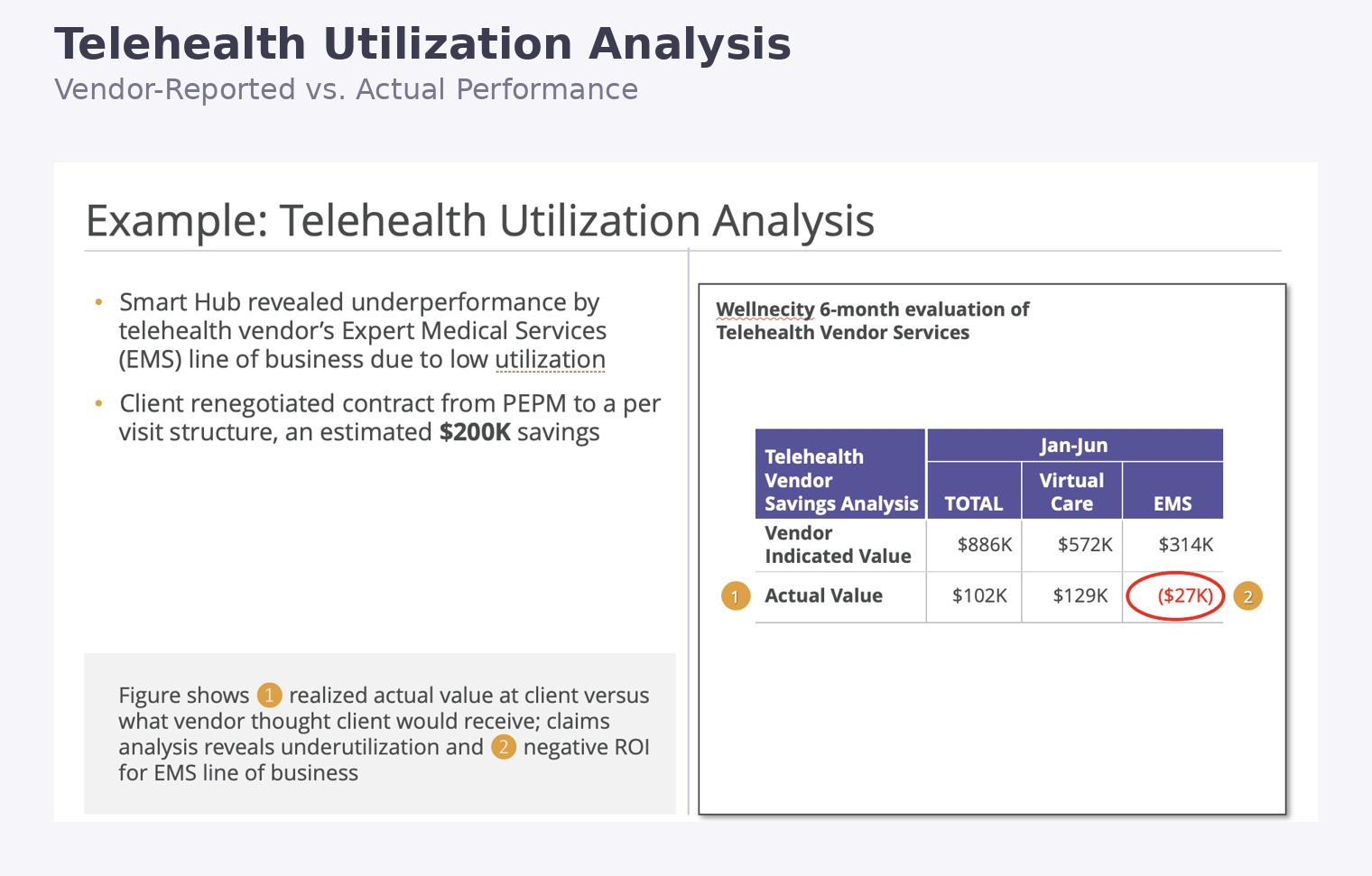
In the example below, vendor-reported value suggested strong performance for telehealth utilization. When measured against the actual data, however, it turns out that strong performance was not as strong as reported. Utilization was lower than expected, and the EMS line showed negative ROI. With that visibility though, the employer moved from a PEPM model to a per-visit structure, resulting in an estimated $200K in savings. Independent validation made it possible to identify the gap between reported performance and actual utilization, giving the employer the visibility needed to revise its telehealth model.
Reporting vs. Governance
Employers aren’t short on reports, they’re short on validation. Vendor reporting plays a role, but governance comes from understanding what’s actually happening across the plan and being able to verify results against actual outcomes. If independent validation is not happening, that’s a problem and exposes the employer for not satisfying its fiduciary duty.