
The journey to treat cancer is arduous, complicated, and expensive. Cancer care is the highest spend category for high-cost claimants in many employers' health plans. Effective cancer care is a function of three key variables:
In this second installment, we address the importance of choosing the right care team. As with all complex health episodes, using the most appropriate care team dramatically increases the probability of a better outcome and cost-effective treatment.
Complication
Unfortunately, despite the importance of making informed decisions when selecting a cancer care team, it's difficult for employers to ensure members are getting the best care. Suboptimal cancer care can include the wrong care plan and overtreatment — unnecessary chemotherapy, surgeries, and radiotherapy — with devastating consequences: lower probability of survival, more complications, and extended periods of uncertainty and fear.
"If your employee gets ovarian cancer and they live in Oklahoma City, how do you enable them to make the best choices for their care?"
There are 3 primary challenges to overcome:
- Cancer care varies substantially across practices
There are more than 50 different types of cancer, and not every practice is excellent at treating every type. New treatments emerge constantly, leading facilities have greater access to new technology, and the cost of the exact same cancer drug can vary widely depending on site of care. Choosing care team A vs. care team B can make a dramatic difference in quality of life and cost of treatment. - The information needed to evaluate trade-offs is not readily available
Experts agree that the information to make better choices is often simply not available. To aggregate all the information needed to address every possible employee situation would be an immense research project. - Members are challenged to evaluate trade-offs
Some cancer patients do not wish to be deeply engaged in information gathering and decision-making. The decisions are complex even for people with clinical backgrounds — how many surgeries per year means a physician is sufficiently experienced? Is academic expertise important for this cancer? Is access to clinical trials important, and if so, which hospitals provide it?
Solution
Self-insured employers have the opportunity to augment the resources available in their health plan. Companies have done — and continuously update — the immense research needed to provide employees with the information and insight to make well-informed choices. Wellnecity has partnered with Cancer Study Group to provide employers and their employees access to this mission-critical insight and empathetic coaching.
Because we think this enhancement is so essential, we have made it part of our Better Care Bundle — a set of important capabilities that we bring when clients deploy us to improve how their health plan operates.
You might ask: if your health plan has an oncology Center of Excellence program, doesn't it already do this? The answer is: if yes, not well enough. The level of research to do this work right is not the type of overhead that every health plan wants to take on — and health plans must be careful not to offend provider partners, making hard choices like not recommending the name-brand local provider very challenging.
Wellnecity Example
Wellnecity's standard claims dataset gives us timely access to new cancer diagnoses among a member population. About 0.6–0.7% of a population will have a new cancer diagnosis each year — per thousand members, about one new cancer case every two months.
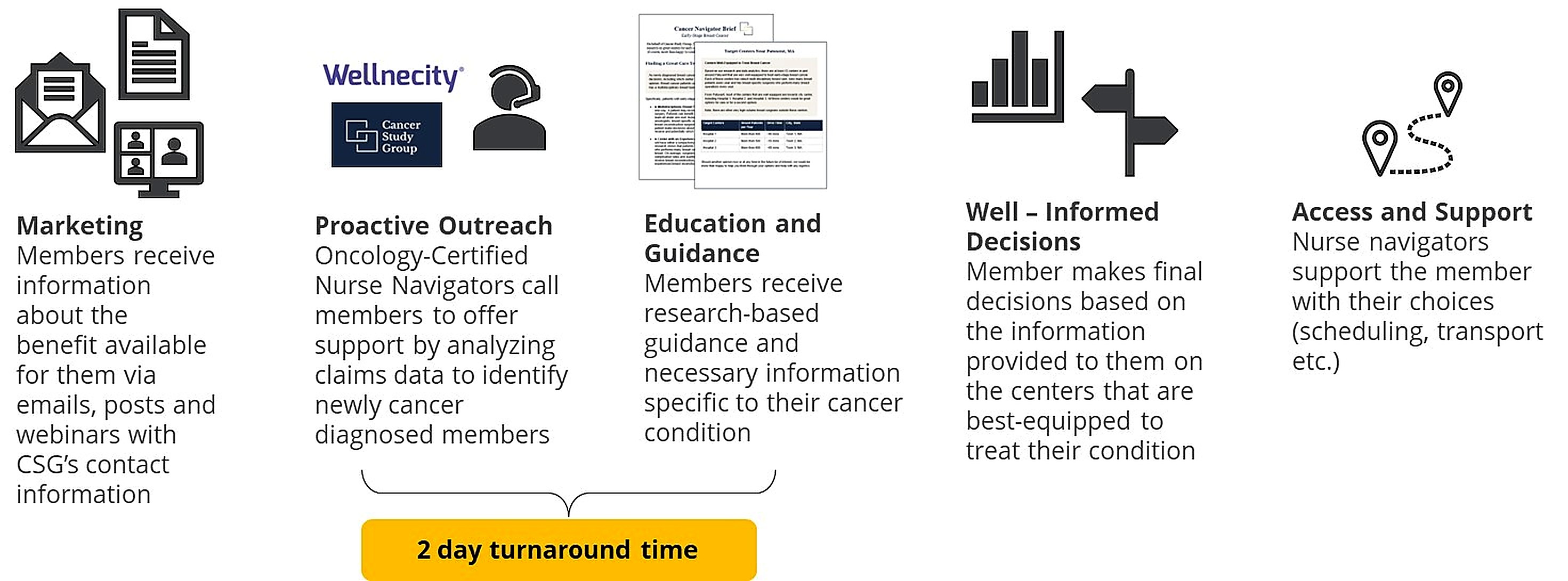
When a new cancer diagnosis trigger appears in claims, Wellnecity immediately notifies Cancer Study Group. Their Oncology-Certified Nurse Navigators proactively reach out to the member to offer empathetic support and guidance — rather than waiting for these often confused and stressed members to call an 800 number themselves.
About two-thirds of members Cancer Study Group contacts accept delivery of a custom Research Brief — delivered in two days or less — with evidence-based guidance in lay-person terms, tailored information on finding a great care team, and options for cancer centers nearby with relevant case volumes and metrics.
The patient and their caregivers ultimately make the final decision on care team, enabled by timely and accurate information. Throughout the process, they are supported by a qualified oncology nurse who helps gather records, answers questions, and handles logistics like appointment scheduling.
Get Insights Delivered to Your Inbox
Practical strategies for self-funded health plan management, delivered regularly.
Subscribe to Insights