
The journey to treat cancer is arduous, complicated, and expensive. Cancer care is the leading category of cost for high-cost claimants in many employers' health plans. Effective cancer care is a function of three key variables:
In this three-part series, we address each variable in sequence, starting here with timely discovery. It is well understood that early detection leads to better outcomes, higher survival rates, and lower cost of treatment.
Complication
The challenge for employers is to maximize compliance with well-established screening guidelines — and current compliance levels are low. For each type of cancer, there are broadly accepted eligibility criteria based on age and other risk factors, and testing intervals. Yet often less than 50% of people who should be screened actually are. Perceived cost and convenience contribute to poor screening rates and, as a result, later detection requiring more invasive treatment.
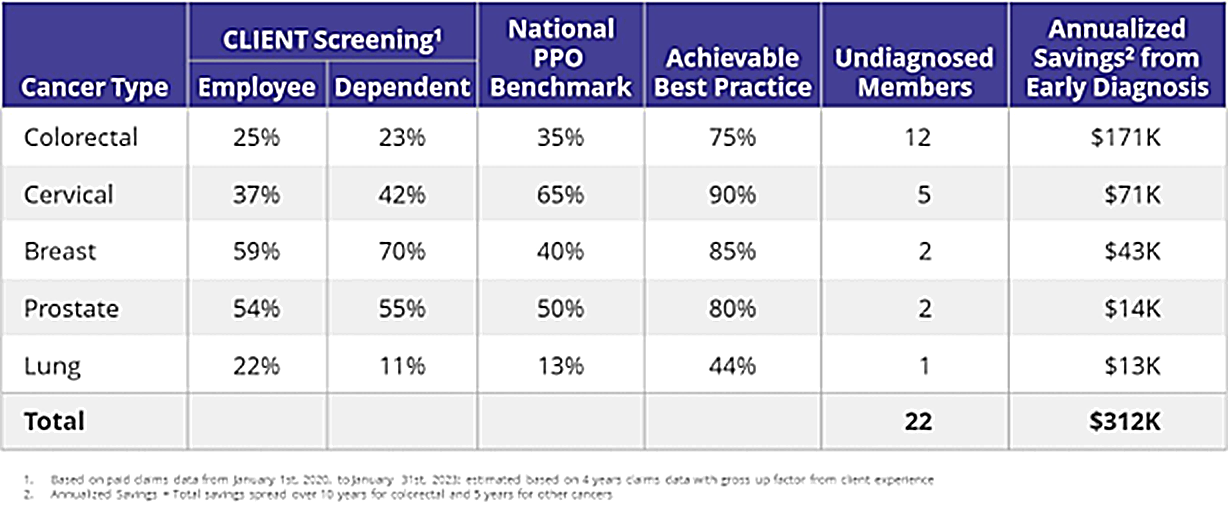
The national average for PPO plans for colon cancer screening is 35%. The best practice observed is approximately 75%. That's a lot of people who could be screened and have their cancer detected while the disease is still easier to treat.
Sadly, many employers believe they are doing the best they can — because brokers and carriers benchmark employers against their peers, rather than a reasonable best practice. There is a substantial difference in treating stage 2 vs. stage 4 colon cancer. Given average screening rates at a typical employer, just over 3 people per 1,000 have diagnosable colon cancer that could be being treated today.
Solution
The solution is straightforward: 1) Understand your screening gap and 2) Close the gap.
To understand your gap, compare your performance to best practices, not your peers. Ask your advisor and carrier for your numbers — if they can't provide the information, you have a more fundamental problem. Compare your numbers to the "achievable best practice" to define your mission: which cancers to focus on, where the biggest gap is, and where improvement will yield the most benefit.
To close the gap, you need to understand who in your population is not compliant with screening guidelines. Wellnecity creates a profile of the unscreened population and, for employers interested in direct outreach or targeted marketing, a target list. Consider solutions that facilitate compliance such as mobile testing units. If your employees are co-located, a full screening event can be created.
Finally, if you really want to get proactive, keep an eye on Grail — this company has developed a multi-cancer blood test called the Galleri test, which covers many previously unscreenable cancers. The "liquid biopsy" solution space is expected to develop rapidly.
Above all, get informed and get active. Lives are at stake.
Wellnecity Example
The following exhibit of screening rates is from a Wellnecity client in the physician services space. The table demonstrates the gap in current performance, the lives impacted, and the projected cost impact due to potential later-stage discovery. The annualized savings are based on avoided direct treatment cost and do not include the added non-trivial burden on patient and family, or lost work.
Get Insights Delivered to Your Inbox
Practical strategies for self-funded health plan management, delivered regularly.
Subscribe to Insights